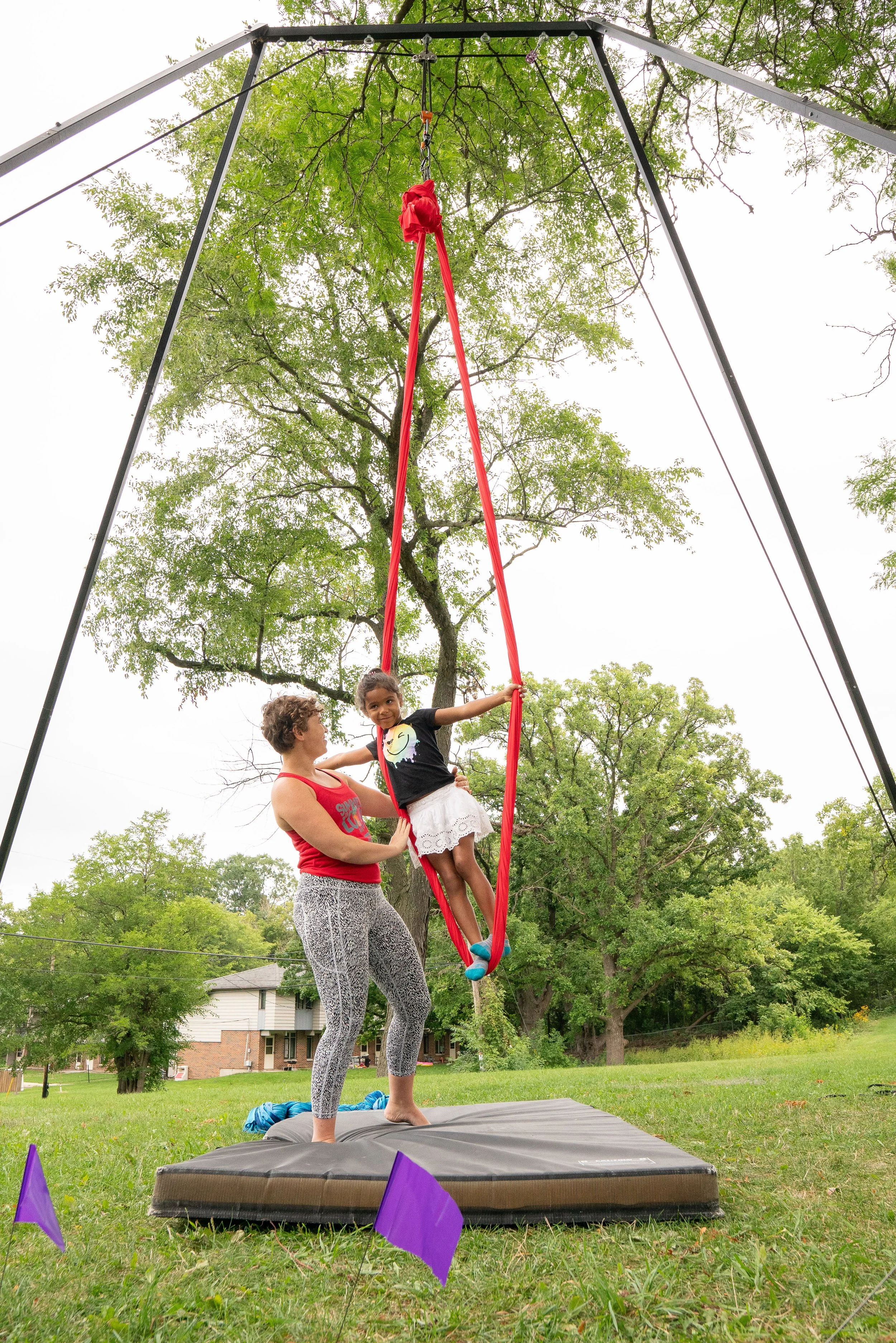
A Parent’s Guide to Safe Aerial Silks Training at Home
First, I want to acknowledge something important: if you’re researching this and consulting a structural engineer, you’re already doing more than many parents do. Supporting your child’s passion while thinking about safety is admirable.
Aerial arts are beautiful, empowering, and deeply creative. They build strength, confidence, resilience, and support healthy “risky play,” which is beneficial for brain development. With that said, aerial silks are also high-risk equipment. The goal is not to discourage—but to ensure safety for your child and everyone who enters your home.
Before Installing Silks at Home
As an instructor, I strongly recommend that students:
Train consistently with a professional instructor for several years (typically 3–5 years).
Never train alone.
Complete a basic rigging course.
Practice rescue techniques for someone who becomes stuck in a tangle.
Only rehearse skills at home that have already been taught and corrected by an instructor.
Continue taking classes to learn new skills and build community.
The Reality of Home Rigging
Safe home rigging involves:
A licensed structural engineer
A professional aerial rigger
Proper ceiling reinforcement is extensive and expensive. In most cases, a fully engineered ceiling rig costs more than purchasing a high-quality freestanding rig (such as those made by Circus Gear). A properly engineered home setup can cost $3,000 or more. In the first 3–5 years of training, many families find that investing in extra classes, private lessons, or supplemental training (gymnastics, dance, yoga) provides greater benefit and safety than installing a home rig.
Why Extra Caution Is Necessary
Many parents don’t realize how dangerous silks can be—not just for their own child, but for visiting children.
Silks involve:
Dynamic load (forces that exceed bodyweight during drops and swings)
Structural integrity requirements
Fall risk
Tangle/strangulation risk
In recent years, there have been fatalities in the U.S. involving home silks setups where children became tangled without proper supervision. In at least one case, the child was not formally trained but had been shown a few moves by a friend. This risk applies to any child in your home.
If You Decide to Have Silks at Home
If you move forward, these are essential safety standards:
1. Use Professional Equipment Only
Purchase equipment from reputable aerial suppliers. Do not use knockoff kits or uncertified hardware.
Avoid DIY ceiling installations in standard residential construction.
Do not rig into home ceilings unless you live in a properly engineered space.
A freestanding rig is significantly safer than a residential ceiling point.
2. Work With Your Child’s Instructor
Inform the instructor about the home setup.
Get clear boundaries on what skills are appropriate to practice.
No new skills at home—only repetition of mastered material.
Without coaching corrections, students often reinforce unsafe habits.
3. Use Proper Mats
No single mat is appropriate for every skill.
Crash mats must match the activity.
Mats must fully cover the fall zone.
Inspect regularly for wear and compression.
4. Create Non-Negotiable House Rules
A. Supervision
Someone must be physically present in the room.
They must be actively watching (not on a phone).
B. No New Skills
Practice only previously taught material.
C. Restricted Access
Only students enrolled in aerial classes may use the silks.
“No class = no fabrics.”
5. Learn Rescue Procedures
Tangles are not “if”—they are “when.”
Parents must:
Learn how to safely assist from the ground.
Understand how not to pull or lift incorrectly (which can worsen the entrapment).
Keep emergency safety shears within reach.
Keep a ladder set up and accessible during use.
Act quickly if a child is stuck.
If you don’t know how to get someone out of a tangle, you cannot safely supervise.
Final Thoughts
It’s wonderful to support your child’s love of aerial arts. The goal is to nurture that passion while modeling safe practices—for your child and for the broader aerial community.
With the right training, supervision, and boundaries, aerial can be transformative. Without them, it can be devastating.